
Implant dentistry in Doral, Miami
All-on-4 dental implants in Miami, a full arch on four implants
All-on-4 dental implants replace a full arch of teeth with a fixed bridge held by four implants: two upright at the front and two angled at the back. The angle lets the implants use the bone you already have, which in many cases means no bone graft. Dr. Helen Carmenate tells you at the consultation whether four implants suit your jaw or whether another plan would serve you better.
- Implants per arch
- 4
- The bridge
- Fixed, not removable
- Financing
- CareCredit, Alphaeon
What All-on-4 dental implants are
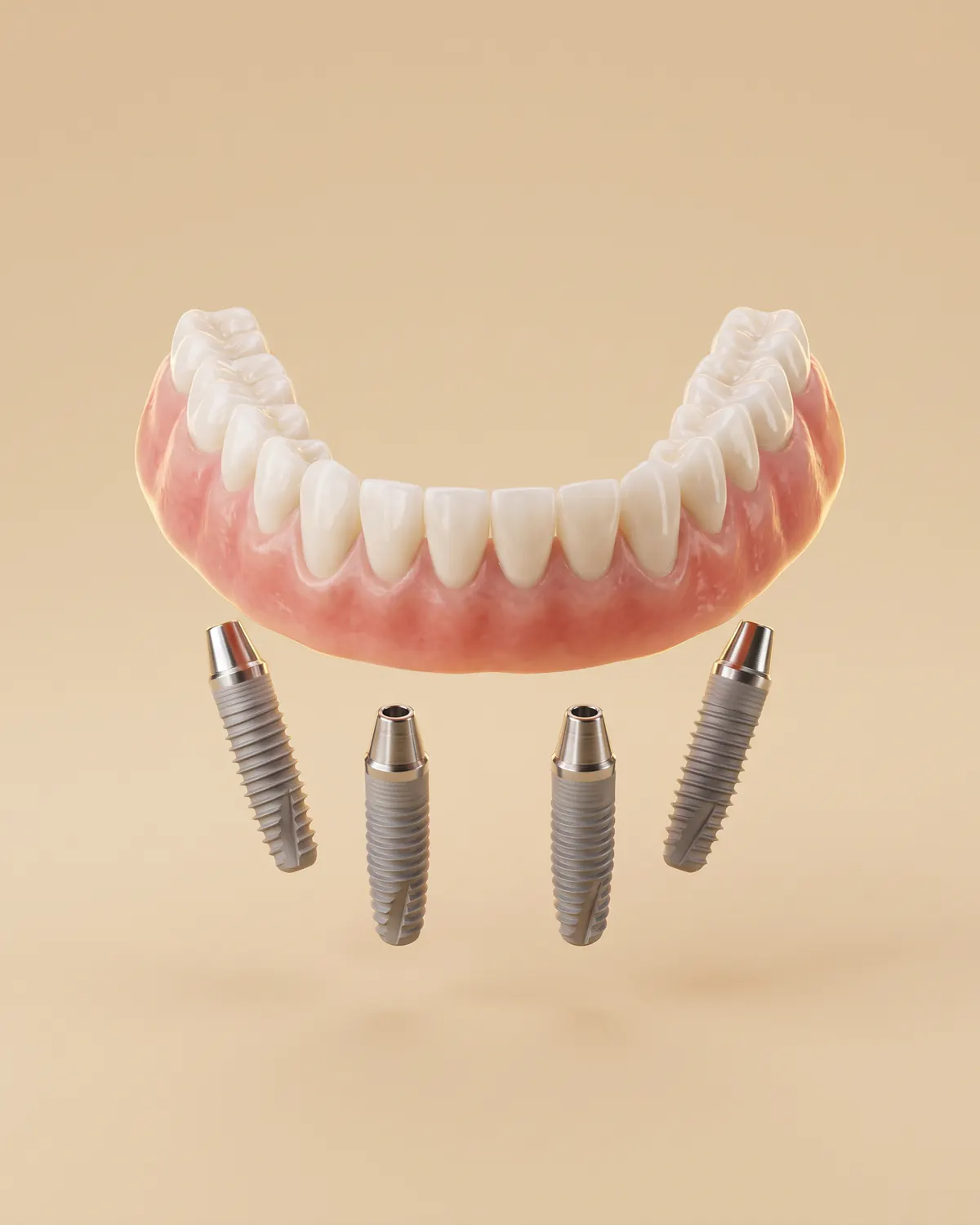
All-on-4 is one of several ways to get full mouth dental implants. The name is a trademark for a specific method for rebuilding an arch with no teeth left. Two implants go into the front of the jaw, straight up. Two more go in further back, tilted at up to 45 degrees. The tilt lets the back implants be longer and grip more bone while staying clear of the sinus in the upper jaw and the main nerve in the lower jaw. That is why this method can often skip the bone grafts and sinus lifts that straight implants in the back of the mouth would need.
The four implants hold one fixed bridge that replaces every tooth in the arch. It is often called a hybrid prosthesis, and it can be made in acrylic over a metal frame, in zirconia or in porcelain; our article on porcelain and hybrid prostheses compares them. In the published studies of this technique, a temporary bridge was attached within 48 hours of surgery, so patients did not go without teeth while they healed.
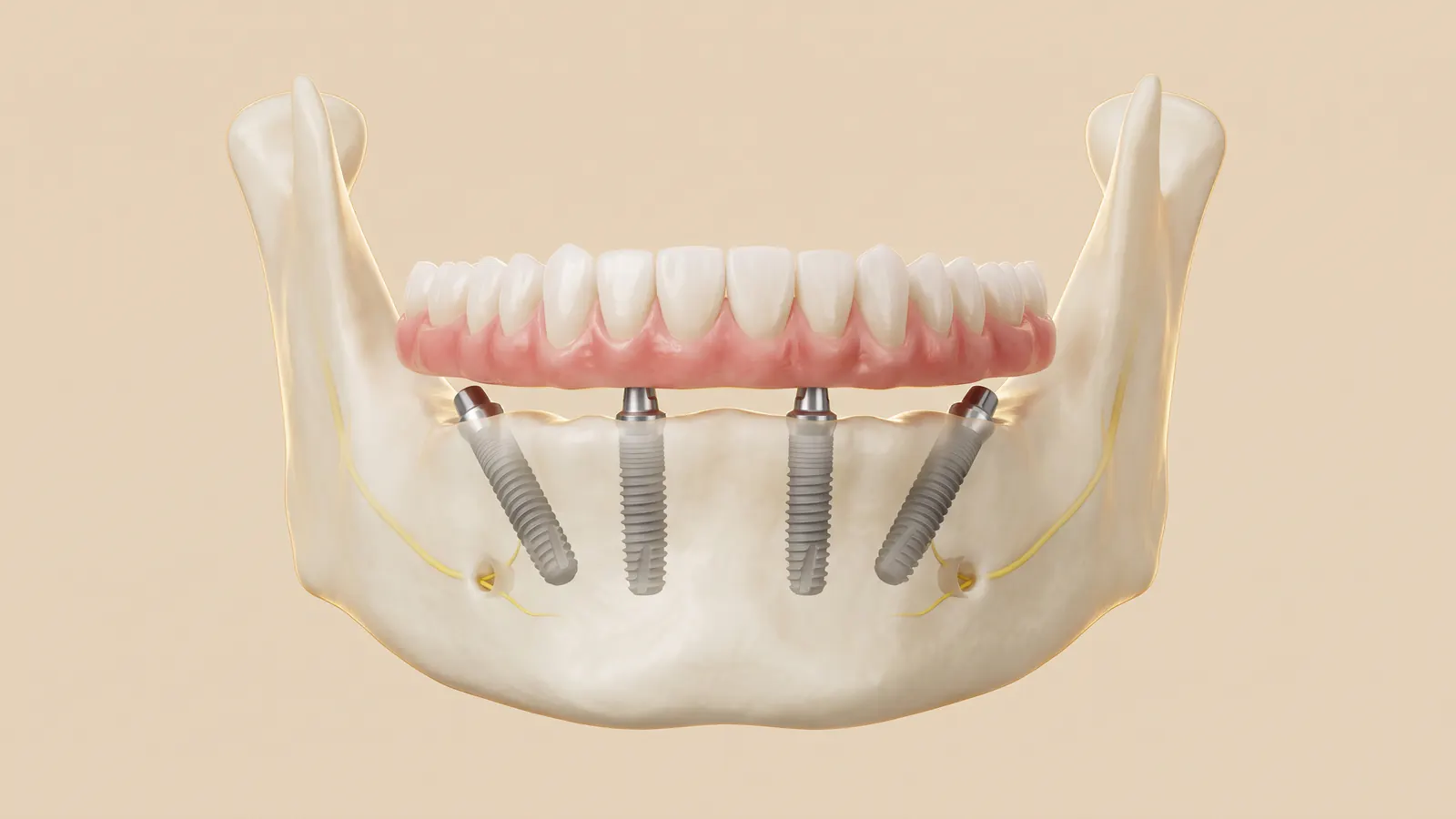
- One-piece fixed bridge. Replaces every tooth in the arch and is screwed onto all four implants.
- Straight front implant. Two implants placed upright in the front of the jaw.
- Tilted back implant. Angled up to 45 degrees so it can be longer and grip more bone, often without a bone graft.
- Mental nerve. The nerve that gives feeling to the lower lip and chin leaves the jaw through a small opening on each side. The tilt keeps the back implants clear of it.
- Lower jaw. The wide spacing between the four implants spreads the chewing load across the arch.
Who All-on-4 is for
It works best when the front of the jaw still has good bone.
- You have lost, or are losing, every tooth in an arch. All-on-4 replaces the whole arch at once, upper, lower or both.
- Your denture moves or hurts. A bridge fixed to implants does not slip, and you no longer need adhesive.
- You were told you need bone grafts at the back of the jaw. Tilting the back implants often avoids them, as long as there is enough bone toward the front.
- You want teeth that stay in. You brush the bridge like teeth; it does not come out at night.
- Your gums and health are in order, or can be. Gum disease is treated before surgery, and conditions such as diabetes need to be under control.
When we suggest something else. If you still have healthy teeth worth keeping, we plan around them rather than remove them. If the bone at the front of the jaw is too thin, you may need more implants, a bone graft or a different plan. If you would rather take your teeth out to clean them, a snap-in implant denture may suit you better.
How All-on-4 dental implants work, visit by visit
You leave the surgery with fixed teeth, and get your final bridge a few months later.
-
Consultation and planning
We examine your mouth, take X-rays and, where needed, a CT scan to measure the bone, and review your health history. If All-on-4 fits, we plan where each implant goes.
First visit
-
Surgery and temporary teeth
Any remaining teeth that cannot be saved are removed, and the four implants are placed under local anesthesia. When they are stable enough in the bone, a temporary fixed bridge goes on the same day or within 48 hours.
Surgery day
-
Healing
The bone fuses with the implants over about three to six months. You follow a soft diet at first and come in for check-ups.
About 3 to 6 months
-
Your final bridge
Impressions go to the lab, the final bridge is made and screwed onto the implants, and the bite is adjusted until it feels even.
After healing
What All-on-4 dental implants cost in Miami
We price All-on-4 after the exam, because the number depends on what your mouth needs. The factors listed here are what move it.
Some dental plans pay part of the cost of implants; many pay nothing because they treat them as elective. We check your benefits with you, and you can spread the rest through CareCredit or Alphaeon Credit.
- One arch or both. Each arch is its own surgery and its own bridge.
- The final bridge. Acrylic over a metal frame, zirconia or porcelain.
- Work before surgery. Extractions and gum treatment.
- More than four implants. Some jaws need extra support.
- Imaging and sedation. A CT scan for planning, and sedation if you choose it.
Priced at your consultation. Financing is available through CareCredit and Alphaeon Credit.
- Financing available
- Insurance accepted for covered care
All-on-4 or full mouth dental implants?
Full mouth dental implants is the umbrella term. All-on-4 is one method inside it.
| All-on-4 | Other full mouth implant plans | |
|---|---|---|
| What the term means | One technique for a full arch, with a set number and position of implants | Any plan that replaces all the teeth in an arch with implants: All-on-6, snap-in implant dentures and others |
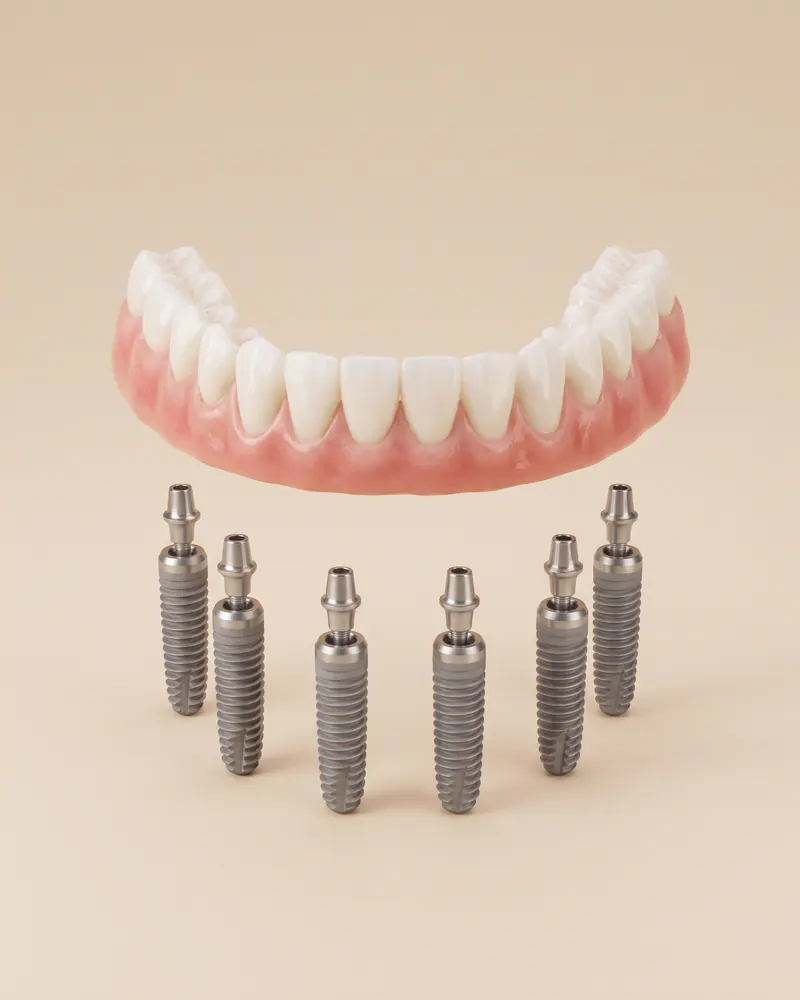
| Implants per arch | Four, the two at the back tilted | From two, for a snap-in denture, to six or more |
| The teeth | A fixed bridge only your dentist can remove | A fixed bridge, or a denture you take out every night |
| Bone grafting | Often avoided thanks to the tilted implants | Sometimes needed where bone at the back of the jaw is thin |
| Temporary teeth | A fixed temporary bridge, usually within 48 hours, when the implants are stable enough | Depends on the plan; a healing denture is common |
Not sure which you need? Our page on full mouth dental implants in Miami covers every option, fixed and removable, side by side. At the consultation we tell you which one fits your bone and your budget.
Recovery and aftercare
- The first days. Expect swelling and soreness, usually eased by over-the-counter pain relievers. Most people return to routine activities in two to three days and feel normal within a week.
- Soft food while you heal. Follow the diet we give you until the implants have fused. Our list of foods to avoid with implants helps.
- Clean under the bridge. Brush twice a day with a soft brush and a nonabrasive toothpaste, then clean underneath with floss threaders, interdental brushes or a water flosser.
- Go easy on hard things. In studies, a chipped or cracked acrylic bridge is the most common problem. Don't chew ice or open packages with your teeth.
- Keep your check-ups. Regular visits and professional cleanings let us spot trouble around an implant early.
- Don't smoke. Smoking slows healing and makes complications more likely.
What patients ask before deciding
How long does All-on-4 surgery take?
Each arch is done in a single surgical appointment. How long it runs depends on how many teeth have to come out first and whether you are treating one arch or both. We give you a time estimate when we plan your case.
How painful is All-on-4?
Local anesthesia numbs the area, so you should not feel pain during the surgery. Soreness and swelling afterward are normal, are usually managed with over-the-counter pain relievers, and fade over the first week.
Do you get temporary teeth while waiting for the final bridge?
Yes, in most cases. When the implants are stable enough, a temporary fixed bridge goes on the same day or within 48 hours. You wear it for the three to six months of healing, until the final bridge is ready.
What disqualifies you from All-on-4?
Usually something that can be treated first rather than a flat no: active gum disease, diabetes that is not under control, or too little bone at the front of the jaw. Some bone disorders and medications raise the risk, and smoking makes healing harder. We go through your health history at the consultation.
Do I have to be put to sleep for All-on-4?
No. Implant surgery is done under local anesthesia, which numbs your mouth while you stay awake. Sedation is an option if you are anxious; we talk through which kind suits you at the consultation.
Can I take All-on-4 teeth out?
No. The bridge is screwed onto the implants and only your dentist can remove it, usually for cleaning or repairs. If you want teeth you can take out each night, a snap-in implant denture is the option to ask about.
How long do All-on-4 implants last?
The implants can last many years. In a 2021 review of 25 studies, 94% to 98% of implants were still in place after six to eleven years. The bridge wears faster than the implants and may need repairs or a replacement over time.
What should I expect two months after All-on-4?
At two months you are still healing. You are wearing the temporary bridge, eating the foods we cleared you for and coming in for check-ups. The implants usually need three to six months to fuse with the bone before the final bridge goes on.
Related treatments
Your new smile starts with one visit.
Tell us what you would like to change and one of our doctors replies within 24 hours on working days.
- Phone
- 786 981 0655
- Emergencies
- 305 204 9231
- Hours
- Monday–Friday, 9 AM–6 PM. Saturday and Sunday closed.
Online consultation
Send us photos of your smile
Fill out the online consultation form, attach your photos and one of our doctors replies within 24 hours on working days.
Start your online consultation